
 Cart is empty
Honda vs Mercury outboard: prices, weight, reliability and range compared by a dealer that sells both. Motors from $885, shipped worldwide.

Honda vs Mercury outboard: prices, weight, reliability and range compared by a dealer that sells both. Motors from $885, shipped worldwide.

Honda vs Yamaha outboard: specs, prices and reliability compared. We sell both brands with free worldwide delivery. Shop now.

We sell both brands, so we hear the Suzuki vs Yamaha outboard question almost every day. Usually it comes from someone who has narrowed it down to two motors, maybe a DF150 and an F150, and wants a straight answer from someone who is not trying to push one over the other.
Here is that answer. Both are good. Neither is a bad buy. But they are not the same, and the right one depends on your boat, where you use it, how much you want to spend and who will service it. This guide lays out the real differences, the specs side by side, and the prices we charge for each brand, with delivery included anywhere in the world.
Want help picking? Call or WhatsApp us on +1 209 690 5983, or send your boat details through our contact page. We will tell you honestly which one we would put on your boat.
In our shop, the cheapest Suzuki starts at $690 and the cheapest Yamaha at $980. Across most power sizes, Suzuki comes in a bit cheaper. That price gap is the first thing most people notice in any Suzuki vs Yamaha outboard comparison.
Yamaha Motor has been making outboards since 1960 and is one of the biggest outboard makers in the world. Its motors are everywhere, from tiny portables on dinghies to the V8 XTO 425 on offshore boats. In many countries, Yamaha is the default choice for commercial fishermen and charter operators.
Suzuki started building outboards in the 1960s too. It has a reputation for engineering firsts, including big four strokes, Lean Burn fuel control and Selective Rotation on its V6 range. Suzuki also built the first 350 HP outboard with twin counter rotating props, the DF350A.
Both are Japanese, both build almost the entire range from small portables to big offshore engines, and both have strong reliability records. That is why the Suzuki vs Yamaha outboard debate is so close.
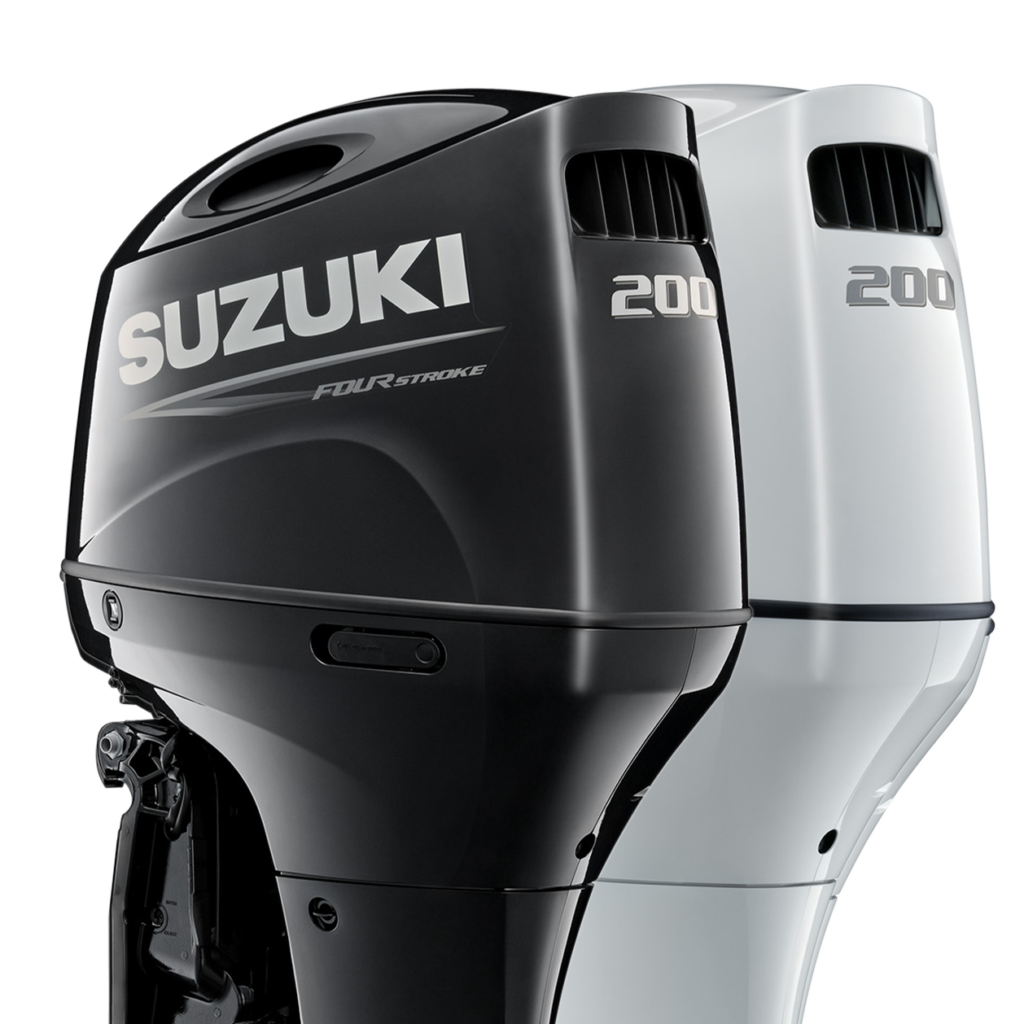
Suzuki is usually cheaper at the same power, sometimes by a lot. On a 200 HP motor in our shop, the Suzuki starts at $6,930 and the Yamaha at $9,000. That gap is the biggest reason people choose Suzuki.
Yamaha has a huge network in many countries, especially in Africa, the Pacific, the Caribbean and parts of Asia. If you are far from a big city, check who can service each brand near you. This one point decides the Suzuki vs Yamaha outboard choice for a lot of overseas buyers.
Yamahas often hold their value a little better, mainly because the name is so well known. Suzukis still resell well, especially newer four strokes.
Suzuki’s Lean Burn system leans out the fuel mix at steady cruise on many models. Owners often report very good economy. Yamaha is also efficient, but Suzuki tends to push this harder.
Many Suzuki models use an offset driveshaft and two stage gear reduction. This allows a lower gear ratio and helps turn bigger props, which is good for hole shot on heavy boats. Yamaha uses big displacement and taller gearing on many of its V6 and V8 motors.
It depends on size. Yamaha’s 4.2 litre V6 is light for its power. Suzuki’s portable and mid range motors are often light too. Check the exact models you are comparing.
Yamaha’s Helm Master EX joystick and built in electric steering on newer V6 and V8 models are a big draw on large boats. Suzuki has Suzuki Precision Control drive by wire and Selective Rotation, which makes twin rigging simpler.
Yamaha’s V8 XTO 425 is one of the most powerful outboards on the market. Suzuki tops out with the DF350A and its twin props. If you need over 350 HP per engine, Yamaha wins.
Both make excellent small motors. Suzuki’s 2.5 and 9.9 lines are popular and good value. Yamaha’s small motors are very well known in commercial use around the world.
Here is a side by side Suzuki vs Yamaha outboard look at popular sizes. Figures are typical and vary by model year and shaft length.
| Size | Suzuki | Yamaha |
| 2.5 HP | DF2.5, single cylinder, 68 cc, about 30 lb | F2.5, single cylinder, 72 cc, about 37 lb |
| 9.9 HP | DF9.9B, 2 cylinder, EFI on most models | F9.9, 2 cylinder, carb or EFI depending on version |
| 150 HP | DF150A, 2.9 litre inline 4 | F150, 2.7 litre inline 4 |
| 200 HP | DF200A, 2.9 litre inline 4 or 3.6 litre V6 | F200, 2.8 litre inline 4 or V6 depending on model |
| 250 HP | DF250T 3.6 litre or DF250AP 4.0 litre V6 | F250, 4.2 litre V6 |
| 300 HP | DF300AP, 4.0 litre V6 | F300, 4.2 litre V6 |
| 350 HP | DF350A, 4.4 litre V6, twin props | F350, 5.3 litre V8 |
| 425 HP | Not offered | XF425 XTO, 5.6 litre V8 |
Want deeper specs on a single motor? See our Yamaha F150 price guide, our Suzuki DF250 price guide and our Yamaha F300 price guide.
These are starting prices from our current listings. Every price includes worldwide delivery. Import duties and local taxes are paid by the buyer.
| Size | Suzuki from | Yamaha from |
| 2.5 HP | $690 | $980 |
| 9.9 HP | $1,699 | $1,350 |
| 90 to 115 HP | 115 HP from $4,679 | 90 HP from $5,130 |
| 150 HP | $8,538 | $13,799 |
| 175 HP | $8,882.50 | $8,855.90 |
| 200 HP | $6,930 | $9,000 |
| 250 HP | $12,331 | Ask us |
| 300 HP | $13,566 | Ask us |
| 350 HP | $16,492 | $17,353.65 |
| 425 HP | Not made | About $23,000 |
Two things stand out. Suzuki is cheaper in most sizes, often by a good margin. And at 175 HP the two are almost exactly the same price, which makes that size a true coin toss in the Suzuki vs Yamaha outboard debate.
For full lists, see our Suzuki outboard prices and Yamaha outboard prices pages.
This is one of the most popular sizes we sell. Suzuki’s DF9.9B is light and most versions are fuel injected, which makes cold starts easy. Yamaha’s F9.9 is everywhere, including High Thrust versions that push heavy sailboats and pontoons well. In our shop the Yamaha actually starts a little cheaper at this size. If you want a trolling kicker, read our best kicker motor for trolling guide and our best 9.9 HP outboard picks.
The DF150 and F150 are both excellent. The Suzuki has a bigger 2.9 litre engine with Lean Burn. The Yamaha F150 is one of the most trusted outboards ever made, especially in commercial use. In our shop, the price gap here is large: a Suzuki 150 starts at $8,538 and our Yamaha F150LB is $13,799. That gap pushes a lot of recreational buyers to Suzuki. Read our guide on how much a 150 HP outboard costs.
Suzuki’s DF200A is a strong inline four at a very attractive price. Yamaha’s F200 comes in both inline four and V6 forms. With Suzuki from $6,930 and Yamaha from $9,000 in our shop, this is another size where the Suzuki vs Yamaha outboard choice often comes down to budget. See our Suzuki 200 HP guide.
Suzuki’s DF300AP and DF350A against Yamaha’s F300 and F350. Suzuki’s DF350A has twin counter rotating props for grip and control. Yamaha’s F350 is a big V8 with lots of torque. Both are serious offshore engines. Our guide on how much is a 300 HP outboard compares this class in detail.
If you need 425 HP from one engine, Yamaha’s XTO is the answer. Suzuki does not make anything this big. See our Yamaha 425 HP guide.
At steady cruise, the engine computer reads conditions and leans the fuel mix to save fuel. You do not have to do anything. It just happens.
The crankshaft sits ahead of the driveshaft. This moves weight forward and allows two stage gear reduction, which means more torque to the prop.
On many big Suzukis, one engine can be set to turn either way. On a twin setup, both engines can be the same model.
Adjusts cam timing as revs change for better low end response and top end power.
On the 4.2 litre V6, the cylinder walls are sprayed on instead of using heavy liners. This allows a bigger bore without a bigger, heavier block.
A joystick and autopilot system for multi engine boats. It makes docking big boats much easier.
None of these features alone should decide the Suzuki vs Yamaha outboard question, but they explain why each brand feels a bit different on the water.
A family pontoon on a lake, budget matters. We usually point to Suzuki. Strong torque, good economy and a lower price.
A fishing boat in a remote coastal town. We usually point to Yamaha, if that is what local mechanics know. Being able to get it fixed quickly beats saving money up front.
A twin engine center console. Either works. Suzuki’s Selective Rotation is handy. Yamaha’s Helm Master EX is great if you want a joystick.
A sailboat auxiliary. Either. Pick the one with the right long shaft and charging output, then go with price.
A boat you plan to sell in a couple of years. Yamaha may give you a little more back at resale.
If your situation is not here, ask us. Most Suzuki vs Yamaha outboard questions can be settled in a five minute call.
Both make light, reliable portables. Suzuki is cheaper. Yamaha is easier to service in remote places. See our dinghy outboard motors.
For a 6 to 9.9 HP long shaft auxiliary, both are fine. Look at shaft length and charging output. See our sailboat outboard motors.
Suzuki’s torque and low gearing work well on heavy pontoons. Yamaha’s High Thrust models are also excellent. See our pontoon outboard motors.
Yamaha’s V MAX SHO is a favourite with bass anglers. Suzuki’s SS models are a lower cost alternative. See our bass boat outboard motors.
Both are excellent. Yamaha has the bigger top end and Helm Master EX. Suzuki offers strong value and Selective Rotation for twins. See our center console outboard motors.
In many countries Yamaha is the standard simply because every mechanic knows it. That can matter more than anything else in a Suzuki vs Yamaha outboard decision for a working boat.
A lot of our buyers are overseas, and for them the Suzuki vs Yamaha outboard question has an extra layer. Local prices for both brands can be far higher than US prices once import costs, taxes and dealer margins are added. Because our prices include delivery, many buyers find they can get either brand from us for less than their local dealer charges, even after paying duty.
Before you choose, check three things where you live. First, who services each brand, and how far away are they? Second, how easy is it to get common parts like impellers, filters and anodes? Third, how does warranty work for an imported engine? The answers often tip the Suzuki vs Yamaha outboard decision one way or the other.
In much of the Pacific, the Caribbean and Africa, Yamaha tends to have the edge on service. In parts of Europe, Asia and Australia, both brands are well supported, so price and features matter more.
On running costs, the Suzuki vs Yamaha outboard gap is small. Routine service is similar for both: oil, filters, plugs, gear oil, anodes and water pump impellers. Parts prices vary by country and dealer. In general:
Follow the service schedule and either brand can run for thousands of hours. Read our guides on how long outboard motors last and how to winterize an outboard motor.
In salt water, the Suzuki vs Yamaha outboard difference is smaller than most people think. Both brands put a lot of work into corrosion protection, with special coatings, sacrificial anodes and stainless parts in key places. In real life, how you look after the motor matters more than the badge. Flush after every saltwater trip, check anodes, and keep the cowl clean. See our saltwater outboard motors for both brands.
Warranty rarely settles a Suzuki vs Yamaha outboard choice on its own. Both offer factory warranties on new motors, and both run promotions that extend coverage at times. Terms vary by country and by whether the use is recreational or commercial. Always check how warranty works where you live before buying. If you are importing, ask how claims are handled by local dealers.
The Suzuki vs Yamaha outboard question applies to used motors too. Used motors from both brands can be good value. Check hours, service records, compression, and corrosion. Our guide on how to check a used outboard before buying covers it. For many buyers, our new prices are close enough to used prices that new makes more sense.
If you asked us to sum up the Suzuki vs Yamaha outboard question in one line, it would be this: buy the Suzuki if value matters most and you have service nearby, and buy the Yamaha if service everywhere and resale matter most.
For most recreational boaters in North America, Europe and Australia, both are easy to service, so Suzuki’s lower price is hard to ignore. For buyers in remote areas, or anyone running a working boat, Yamaha’s network can be worth paying for. For the biggest offshore boats, Yamaha’s V8 range and helm tech give it an edge.
One more thing we have noticed over the years. People who agonise for weeks over a Suzuki vs Yamaha outboard decision are almost always happy with whichever one they pick, as long as it is the right size, has the right shaft, and gets serviced on time. The things that really cause trouble are the wrong prop, skipped flushing and missed oil changes. Get those right and either badge will serve you well for a long time.
We do not push one brand. We make our money either way. What we care about is that you buy the right motor and come back next time.
Answer those and the Suzuki vs Yamaha outboard choice usually makes itself.
Mercury is the third big name. It is strong in North America and has a wide range, including the Verado and big V8 FourStrokes. If you are still deciding, read our Yamaha vs Mercury outboard comparison and our ranking of the best outboard motor brand. Honda and Tohatsu are also worth a look. See our Tohatsu vs Mercury guide and Honda outboard prices.
Browse every Suzuki outboard and every Yamaha outboard, or read our reviews. Shipping overseas? See our guide on how to ship an outboard motor overseas.
You may also like our Honda vs Suzuki outboard and Yamaha vs Tohatsu outboard guides.
Both have excellent reliability records. Maintenance and care matter more than the brand.
Suzuki in most sizes. In our shop, a Suzuki 200 starts at $6,930 and a Yamaha 200 at $9,000.
Suzuki’s Lean Burn often gives it an edge at cruise, but both are efficient.
In many countries, Yamaha, because of its larger network.
Yamaha usually holds value a little better.
Yes. Delivery is included worldwide. Import duty and local taxes are separate.
It is not a good idea. Use matching engines and controls.
There is no wrong answer in the Suzuki vs Yamaha outboard debate, only a better fit for your boat and where you use it. Suzuki gives you more for your money. Yamaha gives you a huge network and strong resale. Tell us about your boat and we will give you an honest recommendation, with the price in writing and delivery included.
Call or WhatsApp +1 209 690 5983, use our contact page, or browse the shop.

Best outboard motor brand? We rank Yamaha, Mercury, Suzuki & Honda and sell them all with free worldwide shipping. Shop now.
You cannot copy content of this page