
 Cart is empty

Ask ten boat owners about Yamaha vs Mercury outboard motors and you’ll get ten strong opinions, usually based on whatever their dad ran. We sell both brands, so we don’t have a horse in the race. Here’s our honest answer up front: both make excellent motors. Yamaha tends to win on resale value and on parts support in far-flung places. Mercury tends to win on weight, on price in a lot of horsepower classes, and on how many dealers it has across North America.
The right choice depends on your boat, where you use it and how long you plan to keep the motor. This guide goes through the Yamaha vs Mercury outboard question class by class, with real specs and the prices we sell them at, so you can make the call yourself. Every motor we sell ships worldwide with delivery included.
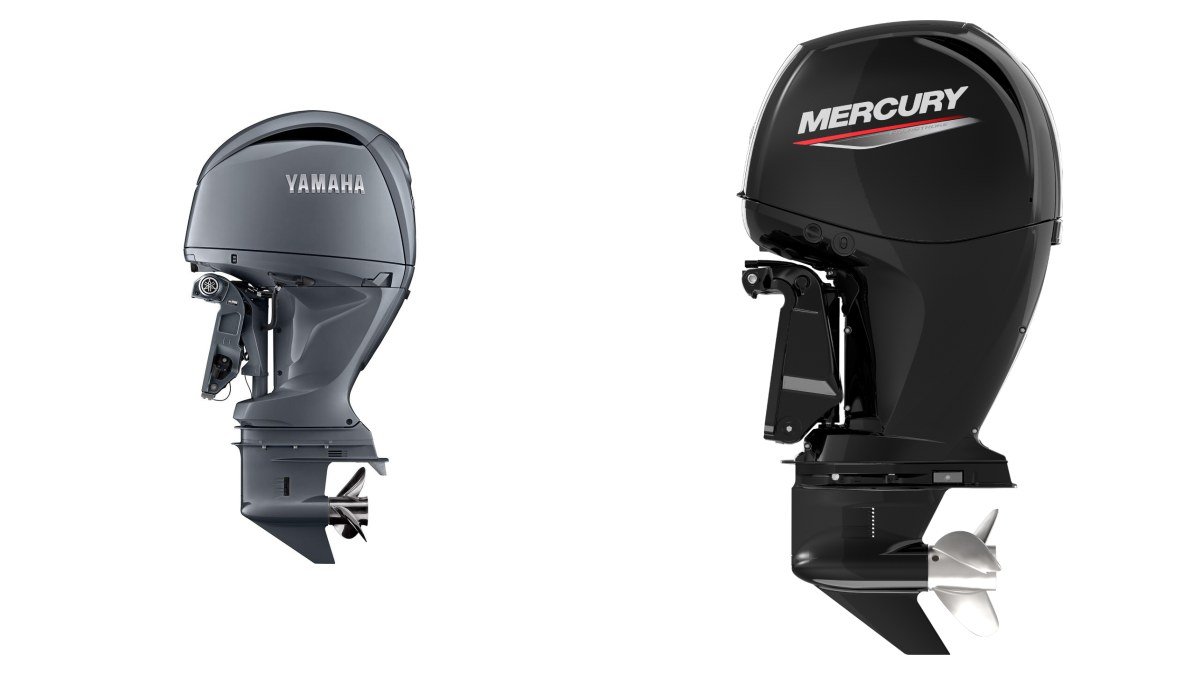
Yamaha vs Mercury Outboard: The Quick Verdict
| What matters | Yamaha | Mercury |
|---|---|---|
| Resale value | Usually the highest of any brand | Good, a step behind Yamaha |
| Weight | Often a little heavier | Lighter in most classes |
| Displacement at 150 HP | 2.7 litre inline 4 | 3.0 litre inline 4 |
| Valve maintenance (75 to 150 HP) | Periodic valve clearance checks | Maintenance-free valvetrain design |
| Dealer network | Very strong worldwide | Very strong in North America and Australia |
| Big offshore motors | V6 and V8 up to 425 HP | V6, V8, V10 and V12 up to 600 HP |
| Performance bass motors | V MAX SHO range | Pro XS range |
| Our price on a typical 200 HP | Yamaha F200LB $9,765 | Mercury 200L Pro XS $8,095 |
That table won’t settle it for everyone, and it shouldn’t. Read on for the detail that matters for your boat.
A Bit of Background on Both Brands
Mercury Marine was started in Wisconsin in 1939 by Carl Kiekhaefer, and it’s still based in Fond du Lac today. It’s part of Brunswick, which also owns a lot of the boat brands you’ll see on the water. That’s one reason so many new boats in North America come rigged with a Mercury from the factory.
Yamaha built its first outboard in Japan in 1960 and grew into the biggest-selling four stroke brand in a lot of the world. Its motors earned a reputation in commercial fishing fleets and in places where the nearest mechanic is a long way off. That reputation is a big part of why Yamaha holds its value so well.
Neither company is a newcomer, and neither one makes a bad motor. The Yamaha vs Mercury outboard debate is really about details, not about one brand being good and the other being junk.
Yamaha vs Mercury Outboard at 150 HP
This is the class most people are shopping, so it gets the most attention. Both motors are the default choice for 18 to 21 foot center consoles, bay boats, deck boats and bigger pontoons.
| Spec | Yamaha F150 | Mercury 150 FourStroke |
|---|---|---|
| Engine | Inline 4, DOHC, 16 valve | Inline 4, SOHC, 8 valve |
| Displacement | 2,670 cc | 3,000 cc (183 cu in) |
| Bore x stroke | 94 x 96.2 mm | 102 x 92 mm |
| Approx. dry weight | about 480 to 510 lb depending on version | 455 lb (lightest version) |
| Alternator | 35 amp | 60 amp, belt driven |
| Full throttle range | 5,000 to 6,000 rpm | 5,000 to 5,800 rpm |
| Gear ratio | 2.00:1 | 1.92:1 |
| Shaft lengths | 20 and 25 inch | 20 and 25 inch |
On paper, the Mercury has more displacement, less weight and a bigger alternator, which is handy if you run a lot of electronics. The Yamaha has a longer track record. The F150 has been around in one form or another since the early 2000s and has a reputation for being very hard to kill. If you’re comparing these two directly, we’ve written dedicated pages on the Yamaha F150 price and the Mercury 150 FourStroke price, plus a broader answer to how much a 150 HP outboard costs.
We currently have the Yamaha F150LB in stock at $13,799, delivered. Mercury 150s come and go, so message us for current availability.
Yamaha vs Mercury Outboard in Small Portables (2.5 to 30 HP)
Small motors get overlooked in the Yamaha vs Mercury outboard debate, but this is where a lot of people start. Tenders, canoes, jon boats and small aluminum fishing boats all run on motors under 30 HP.
Both brands make four stroke portables from 2.5 HP up. Mercury’s small FourStrokes are simple and light, and the 25 and 30 HP EFI models are some of the easiest small motors to start and live with. They’re fuel injected, so there’s no carburettor to gum up if the motor sits for a few weeks. Yamaha’s small motors are famously tough, and its 9.9 HP models are a favourite as kicker motors on bigger boats, especially the high thrust versions.
Here’s a quick look at a few small motors we stock:
- Mercury 25MH EFI tiller: $2,290
- Mercury 30MHGA tiller: $2,719
- Mercury 40MHGA tiller: $3,093
- Yamaha 9.9 HP models: see the Yamaha 9.9 HP range
- Mercury 9.9 HP models: see the Mercury 9.9 HP range
For a trolling or backup motor, our post on the best kicker motor for trolling compares the options in more detail, and the best 9.9 HP outboard guide goes model by model.
At this size, honestly, the Yamaha vs Mercury outboard choice comes down to price, weight and which one your local shop can service. Pick up both if you can and see which one you’d rather carry down a dock.
Yamaha vs Mercury Outboard in the 90 to 115 HP Range
This is pontoon and family runabout territory. Yamaha’s F90 and F115 share a 1,832 cc inline 4. Mercury’s 90 and 115 FourStroke use a 2.1 litre inline 4, and the 115 weighs around 359 lb in its lightest version, against roughly 375 lb for the Yamaha F115. Both are smooth, quiet and frugal at cruise.
Where they differ is the feel. The bigger Mercury block tends to pull a heavy pontoon out of the hole a little harder. The Yamaha revs more freely and feels slightly more refined at the top end. Most owners would never notice either difference without running them back to back.
One of the best value motors we have in this class is the Yamaha F90XB at $5,130. Browse the full Yamaha 90 HP range for more options.
Yamaha vs Mercury Outboard From 175 to 300 HP
Here the two brands take different routes. Yamaha offers big inline 4s at 175 and 200 HP, plus V6 models. Mercury uses a 3.4 litre V6 from 175 to 225 HP and a 4.6 litre V8 at 250 and 300 HP. Mercury’s 175 V6 weighs around 475 lb, and the 250 and 300 V8s come in at roughly 527 lb, which is very light for the power.
Yamaha’s inline 4 F200 is lighter and simpler than a V6, and it’s popular on bay boats. Mercury’s V8 is the motor a lot of offshore anglers have moved to because of the torque.
On our site right now:
- Yamaha F175LA: $8,856
- Yamaha F200LB: $9,765
- Yamaha VF200LA V MAX SHO: $10,734
- Mercury 200L Pro XS TorqueMaster: $8,095
- Mercury 250L FourStroke: $12,127
- Mercury Verado 300L: $14,375
Yamaha vs Mercury Outboard at the Very Top End
If you’re powering a 30 foot plus offshore boat, both brands have serious hardware. Yamaha’s flagship is the XF425, a 5.6 litre V8 with integrated electric steering. Mercury goes further up the scale with the Verado V8, V10 and the huge V12 Verado 600.
We have a good spread of these in stock, including the Yamaha XF425ESA at $23,500, the Yamaha F350XCC at $17,354 and the Mercury Verado 350L at $15,832. Our Mercury Verado for sale page has the full lineup, and the Yamaha 425 HP category lists every XF425 we carry.
Reliability: Is Yamaha More Reliable Than Mercury?
This is the heart of the Yamaha vs Mercury outboard argument, and the honest answer is that a well serviced motor from either brand will run for thousands of hours. The bigger reliability factor is how the motor is treated, not the name on the cowling.
Yamaha’s reputation comes from decades of motors running in harsh commercial use with very little attention. People in remote fishing communities trust them because they keep going.
Mercury’s modern FourStroke line is a big step forward from some of its older two strokes. The 75 to 150 HP FourStrokes use a single overhead cam design that Mercury describes as maintenance free for the life of the motor, so there are no valve clearances to check. Yamaha’s DOHC motors need the valves checked at set intervals, which is normal for most four strokes but is one more job on the list.
Our view after years of selling both: if you look after it, either will outlast your boat. If you won’t look after it, neither will save you. Our post on how to check a used outboard before buying shows what neglect looks like, whatever the brand.
Yamaha vs Mercury Outboard Weight and Performance
Weight matters more than most people think. A lighter motor helps the boat get on plane, keeps the stern higher in the water, and lets smaller boats carry the horsepower they’re rated for without squatting. In most classes Mercury is lighter, sometimes by 20 to 50 lb.
For outright speed, compare the performance lines. Mercury’s Pro XS outboards and Yamaha’s V MAX SHO range are both built for bass boats and fast flats boats. Tournament anglers are split pretty evenly between them. The Pro XS usually wins on hole shot and weight. The SHO is known for strong mid-range and good fuel economy for a performance motor.
Fuel Economy and Noise in the Yamaha vs Mercury Outboard Matchup
Fuel economy between the two brands is close in almost every class. Boat setup, prop choice and load make a far bigger difference than the brand. A badly propped motor can burn 20% more fuel than a well propped one.
Both brands are quiet at idle and cruise. Mercury puts a lot of work into engine mounts to cut vibration at the helm. Yamaha uses a shift dampener system on its props to soften the clunk when you drop it into gear. Honestly, from the helm of a typical boat, you’d struggle to tell them apart.
Yamaha vs Mercury Outboard Parts and Service Around the World
This is where your location really matters. We ship worldwide, and the question we ask every overseas customer is: who’s going to service it?
In the United States and Canada, both brands are everywhere. Mercury probably has the edge in sheer dealer numbers, partly because so many boats are sold with Mercury power. In Australia and New Zealand both are well supported.
In much of Africa, the Middle East, South and Southeast Asia, the Pacific islands and the Caribbean, Yamaha’s network is usually deeper. Parts like impellers, filters, plugs and anodes are easier to find. If you’ll be running far from a big city, that’s a real point in Yamaha’s favour in the Yamaha vs Mercury outboard decision.
Both makers have dealer locators on their own sites. Check Yamaha Outboards and Mercury Marine for the nearest service point to you before you buy.
Yamaha vs Mercury Outboard Resale Value
Yamaha wins here, and it isn’t close. A five year old Yamaha four stroke with good service records sells quickly and holds a strong price. Mercury motors hold value well too, especially the newer FourStrokes and Verados, but buyers on the used market will usually pay a bit more for the Yamaha badge.
If you tend to sell your boat every few years, that resale gap can cover a good chunk of the price difference when you buy. If you plan to run the motor until it dies, resale matters much less.
Yamaha vs Mercury Outboard Prices
At list price, Mercury is often cheaper than Yamaha for the same horsepower, sometimes by a lot. When the Mercury 150 FourStroke launched, it was priced well below the Yamaha F150 on purpose. On our site, prices depend on model year and condition as much as brand, so the gap goes both ways. Here’s a quick look:
| HP | Yamaha from (our price) | Mercury from (our price) |
|---|---|---|
| 40 | $3,690 | $3,093 |
| 150 | $13,799 | message us |
| 200 | $9,000 | $8,095 |
| 350 | $17,354 | $15,832 |
For complete lists, see our Yamaha outboard prices and Mercury outboard prices pages. If you’re hunting for the lowest price, our outboard motor clearance sale lists the cheapest motors we have right now from both brands.
Controls, Gauges and Tech: Yamaha vs Mercury Outboard Electronics
Modern outboards are as much about the electronics as the engine. This part of the Yamaha vs Mercury outboard comparison matters most if you’re rigging a new boat or doing a full repower.
Mercury uses SmartCraft, its system for linking the motor to digital gauges and multifunction displays. On bigger motors it offers Digital Throttle and Shift (DTS), which replaces cables with wiring and gives a very light, smooth control feel. Mercury’s joystick piloting for twin and triple Verados makes docking a big boat much easier.
Yamaha uses its Command Link system for gauges, and Helm Master EX for joystick docking on multi-engine boats. The newer Yamaha F150 and F200 models also come with integrated electric steering options, which cleans up the transom and removes hydraulic lines.
Both systems work well. The catch is that they don’t talk to each other. Mercury gauges won’t read a Yamaha motor and the other way round. That’s one more reason to stick with one brand on a boat unless you’re replacing everything.
Warranty and Support
Both makers offer a standard limited warranty on new recreational motors, typically three years in the US, and Mercury adds a separate corrosion warranty. Terms vary a lot by country, by model year and by whether the motor is new, an earlier model year or used. Warranty registration is also handled through authorised dealers in each country.
Because of that, we don’t make blanket warranty promises in a Yamaha vs Mercury outboard comparison. Ask us about the specific motor you’re looking at and we’ll tell you exactly what applies, in writing, before you pay. Our refund and return policy covers how we handle problems on our side.
What We See From Shipping Both Brands Worldwide
We ship a lot of Yamahas and Mercurys overseas, and a few patterns stand out. Customers on islands and in coastal fishing towns ask for Yamaha far more often, mostly because the local mechanic already knows them. Customers in North America split about evenly, and often just want the cheapest good motor in the right size. Bass boat owners lean Mercury. Offshore boat owners are split, with the big V8s from both brands selling well.
The motors themselves travel well. We crate every one, and our guide to how to ship an outboard motor overseas explains how it works door to door.
Which One Should You Buy? Settling Yamaha vs Mercury Outboard
Here’s how we’d settle the Yamaha vs Mercury outboard question for different buyers.
You’re repowering a boat already rigged for one brand
Stick with the same brand. You can often reuse the controls, harness, gauges and sometimes the prop. Switching brands means new controls and gauges, which can add a surprising amount to the bill. Our outboard repower page explains what’s involved.
You fish saltwater far from big towns
Lean towards Yamaha for parts availability. See our saltwater outboard motor guide for more on corrosion protection.
You run a bass boat or want speed
Either the Mercury Pro XS or the Yamaha V MAX SHO. Many anglers pick the Pro XS for its weight.
You have a pontoon or family boat
Either brand is great. Buy whichever has the better local service and price.
You’ll sell the boat in a few years
Yamaha, for resale value.
You want the most motor for your money
Mercury usually gives more displacement and less weight per dollar at list price. Also look at Suzuki, which we cover in our post on the best outboard motor brand. If you’re also weighing a cheaper brand, our Tohatsu vs Mercury outboard comparison is worth reading.
Common Myths in the Yamaha vs Mercury Outboard Debate
“Mercury is just for bass boats.” Not true. Mercury powers everything from tenders to 40 foot offshore boats, and its SeaPro line is built for commercial work.
“Yamaha can’t be beaten for reliability.” Yamaha’s record is excellent, but modern Mercury FourStrokes are very reliable too. Neglect kills both.
“You have to use the brand the boat came with.” You don’t. It’s just usually cheaper to, because of controls and gauges.
“Older Mercury two strokes mean modern Mercurys are thirsty.” The current FourStroke and Verado lines are as efficient as anything else on the water.
If We Had to Pick One in the Yamaha vs Mercury Outboard Fight
People ask us this all the time, so here’s a straight answer. For a boat that lives in saltwater, gets used hard and might be sold in five years, we’d lean Yamaha. For a freshwater or bass boat, or a buyer who wants the lightest motor and the most displacement for the money, we’d lean Mercury. For a pontoon or a family runabout, we’d flip a coin and then buy whichever one is cheaper on the day.
That’s really the whole Yamaha vs Mercury outboard story. Both are good. Both have fans who will argue about it forever. What matters more is the right horsepower, the right shaft length, a good prop, and a mechanic nearby who knows the brand. Get those right and you’ll be happy with either badge on the back of your boat. Get them wrong and no amount of brand loyalty fixes it.
If you’d like us to look at your boat and tell you which side of the Yamaha vs Mercury outboard line we’d fall on for your setup, send us a few photos of the transom and the capacity plate. We’ll come back with a straight recommendation and a delivered price.
Yamaha vs Mercury Outboard FAQ
Which is better, Yamaha or Mercury outboard?
Neither is better across the board. In the Yamaha vs Mercury outboard comparison, Yamaha leads on resale and global parts support, Mercury on weight, displacement and often price.
Is Mercury lighter than Yamaha?
In most classes, yes. The Mercury 150 FourStroke weighs 455 lb in its lightest form, lighter than the Yamaha F150.
Which brand holds its value better?
Yamaha, generally.
Do you sell both Yamaha and Mercury?
Yes. Browse our Yamaha outboards and Mercury outboards. Both ship worldwide with delivery included.
Can I switch from Mercury to Yamaha on my boat?
Yes. Budget for new controls, cables and gauges, and check the mounting holes line up with your transom.
Can you help me choose?
Of course. Send us your boat make, length, the max HP on the capacity plate, your transom height and where you use the boat. We’ll give you our honest pick, even if it means the cheaper motor.
Final Word on Yamaha vs Mercury Outboard Motors
The Yamaha vs Mercury outboard question doesn’t have one winner. It has a right answer for your boat, your budget and where you go boating. Yamaha is the safe, high-resale choice with parts almost anywhere. Mercury is lighter, often cheaper and offers more choice at the very top. Pick the one your local mechanic knows best and you won’t go far wrong. If you need help with sizing first, read what size outboard for my boat. The team at Discover Boating also has a solid beginner section on engines.
Ready to buy, or still on the fence? Call or WhatsApp us on +1 209 690 5983, send a message through our contact page, or browse the whole shop. You can read more about us too.
Related: Honda vs Mercury outboard Yamaha vs Tohatsu outboard
[…] a very long time. If you want to compare it directly with Mercury’s 3.0 litre 150, read our Yamaha vs Mercury outboard […]