
 Cart is empty
Description
This Yamaha T25LWTC high thrust outboard is new, crated and ready to go out to you. It is the 25 HP version of Yamaha’s High Thrust line, with a 20 inch shaft, electric start and power trim and tilt. We sell it to pontoon owners, sailors and people who run small work boats, and we ship it worldwide.
Quick note on the name. This listing used to be titled as a 30 HP. It is not. The T25LWTC is a 25 HP motor, and the page now describes it correctly. We also list the same model as the Yamaha T25LWTC for sale under our 25 HP section, so if one shows sold out, check the other.
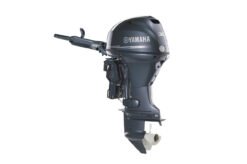
Everything you need is below: specs, how the High Thrust gearcase changes the way a heavy boat behaves, rigging, care, and what to check before you buy. Skip to whatever matters to you.
Yamaha T25LWTC for Sale: Specifications
| Item | Detail |
|---|---|
| Model | Yamaha T25LWTC High Thrust four stroke |
| Horsepower | 25 HP |
| Engine | 2 cylinder, SOHC four stroke |
| Displacement | 432 cc |
| Fuel system | Electronic Fuel Injection, no battery needed to run |
| Shaft length | 20 inch (L) |
| Starting | Electric, with manual backup |
| Trim and tilt | Power trim and tilt |
| Trim range | -3 to +16 degrees |
| Tilt | About 63 degrees |
| Alternator | 16 amp |
| Full throttle range | 5,000 to 6,000 rpm |
| Weight | About 154 lb (around 70 kg), varies by version |
| Lower unit | High Thrust gearcase with Dual Thrust propeller |
| Trolling | Variable Trolling RPM Switch (VTS) |
| Flushing | Freshwater flush port |
| Warranty | Yamaha factory warranty, terms depend on your region |
Weights and small figures can change a little between production years, so check the paperwork that ships in the crate. Yamaha keeps the current numbers on its High Thrust outboard page if you want to compare.
What the Yamaha T25LWTC high thrust outboard Model Code Means
Yamaha codes look like alphabet soup, but they are easy once you know them. T means High Thrust. 25 is the horsepower. L is a 20 inch shaft. W means electric start. T at the end means power trim and tilt. C refers to the control setup. So the Yamaha T25LWTC is a 25 HP High Thrust, 20 inch, electric start motor with power trim and tilt.
If your transom needs a 25 inch shaft, the same motor comes as the T25XWTC. We sell that one too, so do not guess. Measure first, then pick.
What High Thrust Does on the Yamaha T25LWTC high thrust outboard
A normal 25 is geared and propped for speed. That is fine on a light skiff. Put it on a heavy pontoon or a sailboat and it struggles. The prop spins fast, cavitates, and the boat barely moves until you give it a lot of throttle.
High Thrust fixes that with a bigger gearcase, a lower gear ratio and a large Dual Thrust prop. The prop turns slower but grabs far more water. You lose some top speed. You gain a lot of push. Yamaha says its High Thrust models make a lot more forward thrust than a standard motor of the same horsepower, and noticeably more again in reverse.
Reverse is the part people do not expect. Backing a pontoon into a slip in wind, or stopping a sailboat that is drifting onto a dock, is where a normal small motor lets you down. The Yamaha T25LWTC high thrust outboard on this page bites in reverse and actually stops the boat. That alone sells it to a lot of our customers.
Battery-Free EFI on the Yamaha T25LWTC high thrust outboard
The fuel injection on the T25 does not need a battery to run. If your battery goes flat, you can still pull start the motor and it will run on injection. That is a good thing to have on a sailboat or a boat that sits on a mooring for weeks.
With EFI you get easy cold starts, steady idle and better fuel use than an old carbureted 25. No choke, no fiddling. Turn the key, or pull the cord, and it goes.
Boats That Suit the Yamaha T25LWTC
Small and mid-size pontoons
This is the classic job. A pontoon is heavy and sits in the water like a raft. A standard 25 spins its prop and goes nowhere. The High Thrust 25 gets a family pontoon moving properly and holds it on course in a breeze.
Sailboats
Bigger sailboats that use an outboard on a bracket or a well need push, not speed. The Dual Thrust prop and the power tilt make this a strong choice. Tilt it clear of the water when you sail and drop it when you need to motor in.
Work boats and barges
Small work platforms, aluminium punts loaded with gear, dive boats and dock barges all need low speed muscle. The Yamaha T25LWTC high thrust outboard here handles those jobs without screaming.
Heavy fishing boats
A wide multi-species boat full of people, coolers and tackle often feels sluggish with a normal 25. The High Thrust version gets it on plane easier and trolls down slow with the VTS switch.
Rigging the Yamaha T25LWTC for Sale
This version is set up for remote control. You will need a control box, throttle and shift cables, a steering system, a key switch harness and a battery. Many buyers already have these on the boat. If you do not, tell us your boat and we can help you put a list together.
Mount height matters. With a 20 inch shaft the anti-ventilation plate should sit roughly level with the bottom of the hull, or slightly above. Too low and you get drag and spray. Too high and the prop blows out in turns. Start level, test, then raise a hole at a time if you need to.
Use a battery big enough for electric start and whatever you run on board. The 16 amp charging will keep it topped up on a normal day.
How the Yamaha T25LWTC high thrust outboard Runs
At idle the twin is quiet and smooth. Shifting is soft. Push the throttle and you feel the boat get pushed rather than shoved. It is not a fast motor, and that is the point. On a pontoon you get a calm, steady cruise. On a sailboat you get control.
Power trim lets you tuck the motor in to lift the bow, then trim out once you are running. Coming into shallow water or the ramp, lift it with a button. After a few trips you stop thinking about it.
Breaking In the Yamaha T25LWTC high thrust outboard
Follow the break-in in the owner’s manual. In general, keep the first hour or so at low and varied revs, then slowly bring it up. Do not hold full throttle for long periods during the first several hours. Change the oil after the first service interval. You can download manuals from Yamaha’s owner’s manual library.
Maintenance on the Yamaha T25LWTC high thrust outboard
Nothing on this motor is hard to look after. Most owners do the basics themselves and leave the bigger services to a mechanic.
- Flush it with fresh water after every trip in salt or dirty water. The flush port means you do not need to run it.
- Change the engine oil and filter at the intervals in the manual, or once a season if you do not use it much.
- Change gear oil once a season. If it comes out milky, water is getting in and a seal needs looking at.
- Check the anodes. Replace them when they are about half gone.
- Look at the prop for dings and fishing line wrapped behind it.
- Replace the water pump impeller every couple of seasons, sooner in sandy water.
- Keep fuel fresh. Use a stabiliser if it will sit, and fit a water separating filter.
Do that and a Yamaha four stroke will last a very long time. We see plenty of them still running hard after many years of work.
Common Problems With the Yamaha T25LWTC high thrust outboard
Will not start on the key. Check the lanyard is clipped in, the motor is in neutral and the battery terminals are clean. If it still will not turn over, pull start it. The EFI runs without the battery.
Weak tell-tale stream. Usually a blocked tell-tale hole. Poke it clear with a bit of wire. If it is still weak, check the impeller.
Rough idle. Often old or dirty fuel. Drain the filter bowl and try fresh fuel.
Prop blows out in turns. The motor is mounted too high or trimmed too far out. Trim in and check mount height.
Yamaha T25LWTC or a Standard F25?
We get asked this a lot. If your boat is light and you want speed, a standard 25 like the Yamaha F25LC will be faster and a bit cheaper to run flat out. If your boat is heavy, wide, or you need to stop and back up with control, the High Thrust is the one. On a pontoon or sailboat we would pick the T25 every time.
Another option on very small sailboats and tenders is the High Thrust 9.9, such as the Yamaha T9.9LPB. It is lighter, but it runs out of push on anything over a small pontoon. The T25 gives you real margin.
Shaft Length for the Yamaha T25LWTC high thrust outboard
Measure from the top of the transom straight down to the bottom of the hull. Around 20 inches means you want the L shaft, which is the Yamaha T25LWTC high thrust outboard on this page. Around 25 inches means the X shaft, the T25XWTC. Many pontoons use a 20 inch shaft, but some use 25, and sailboats on a bracket vary a lot. If you are unsure, send us a photo and the measurement.
Choosing a Propeller for the Yamaha T25LWTC high thrust outboard
The Dual Thrust prop that comes with the motor is a good all-round choice for heavy boats. It gives strong push forward and in reverse. If your boat is lighter than usual, or you want a bit more speed, you can try a different pitch. Aim for the motor to reach the top of its full throttle range with a normal load. Yamaha has a handy prop selector tool for this.
Repowering an Old Pontoon With the Yamaha T25LWTC high thrust outboard
A lot of our buyers are replacing something. Often it is an old two stroke 25 or 30 that smokes, eats plugs and needs three pulls on a cold morning. Taking it off is usually a two person job. Check the transom wood while it is off, because soft wood behind the bracket is common on older pontoons. Fix that first. Then bolt the new motor on, run the cables, hook up the battery and fuel line, and you are close to done.
The difference on the first run is what people mention. Quieter, no smoke, no smell of two stroke oil on the deck, and the boat actually moves off the dock instead of wallowing. Reverse is the other surprise. With the High Thrust gearcase you can stop a heavy pontoon properly.
Using It on a Work Boat
If your boat earns money, you care about the motor starting every day and not costing a fortune to run. The twin cylinder EFI is simple, parts are easy to get in most countries, and the High Thrust prop means you are not over revving the engine to push weight around. Keep up with flushing and oil changes and it will do the job for years. A small ferry, a marina punt or a dive tender is exactly where this motor is happiest.
Salt Water Care for the Yamaha T25LWTC high thrust outboard
Flush after every trip. Rinse the outside. Spray a corrosion inhibitor on the powerhead under the cowl now and then. Keep anodes fresh. If the boat lives in the water, tilt the motor up when you leave it so the lower unit is not soaking. Yamaha’s paint and alloy hold up well, but salt finds any weak spot if you let it.
Hot and Cold Climates
In hot places, watch the tell-tale stream and keep the cooling system clean. In cold places, the EFI makes starting easy, but drain or winterise the motor properly before a freeze. Use the right oil grade for your temperatures as the manual describes.
What Comes With the Yamaha T25LWTC high thrust outboard
- Yamaha T25LWTC powerhead and High Thrust lower unit
- Dual Thrust propeller
- Owner’s manual and warranty paperwork
- Safety lanyard
Controls, cables, steering, battery and fuel tank are separate unless you arrange them with us. Ask before you order and we will tell you exactly what ships with your motor.
Who Usually Buys the Yamaha T25LWTC high thrust outboard
Most of the people who order the Yamaha T25LWTC high thrust outboard from us fall into a few groups. Pontoon owners are the biggest. They bought a boat with a tired old motor, or a standard 25 that never quite got the boat moving, and they want something that just works. Next come sailors who need a reliable auxiliary that can push a heavy keelboat into a headwind. Then there are people running small commercial boats, ferries across a river, dive tenders, marina work punts. They care about push, uptime and fuel bills, not top speed.
What they all say after a season is roughly the same. It starts, it pushes, it does not drink much and it does not need babysitting. That is about as good as it gets with an outboard.
Fuel Use and Running Costs
A 432 cc twin with fuel injection is thrifty. On a pontoon at a calm cruise you will burn far less than an old two stroke of the same power. Trolling with the VTS switch uses next to nothing. Exact figures depend on your hull, load and how hard you push it, so we will not throw made-up numbers at you. What we can say is that owners who switch to the Yamaha T25LWTC high thrust outboard from an older carbureted motor almost always notice the difference at the fuel dock.
Servicing is simple and parts are easy to find in most countries because Yamaha sells so many of these motors. That keeps long term costs down too.
Before You Order the Yamaha T25LWTC high thrust outboard
- Measure your transom height so you are sure 20 inches is right.
- Check your transom is rated for a motor of about 154 lb plus controls.
- Decide whether you are reusing controls and cables or need new ones.
- Make sure you have a battery and a fuel tank that suit the motor.
- Tell us your country so we can quote shipping on the Yamaha T25LWTC high thrust outboard to your door.
If any of that is unclear, message us before you order the Yamaha T25LWTC high thrust outboard. Ten minutes of questions now saves a lot of hassle once the crate arrives.
Why We Like Selling This Motor
Some motors we sell and never hear about again. That is a good sign, but the Yamaha T25LWTC high thrust outboard is one where people actually write back to tell us how it went. Usually the message is about backing into a tight slip in wind for the first time without drama. Small thing, but if you have ever fought a pontoon in a crosswind you will know why it matters.
Buying the Yamaha T25LWTC high thrust outboard From Us
Every motor we sell is new. The price is on this page. Before we ship, we give you a quote for delivery to your country, so you know the full cost. We ship worldwide and send the export and customs paperwork along with it.
When you order, we confirm stock, the model code and the shaft length with you. Then the crate gets strapped, protected and sent. You get tracking once it is moving. Our refund and return policy and terms are on the site, and you can read what other buyers say on our reviews page.
If you want to know more about who we are, the about page has that. If you just want to talk about whether this motor suits your boat, use the contact page and we will get back to you.
Other Motors Worth a Look
- All 25 HP Yamaha outboards
- Yamaha F25LC, the standard 25 with remote control
- Yamaha T9.9XPB High Thrust, 25 inch shaft
- Yamaha F15LPHA tiller
- Everything in the shop
Our blog has more on rigging and looking after outboards if you like to read up first.
FAQ: Yamaha T25LWTC for Sale
Is the Yamaha T25LWTC high thrust outboard new?
Yes. New, in the factory crate, with Yamaha paperwork.
Is the Yamaha T25LWTC high thrust outboard 25 HP or 30 HP?
It is 25 HP. The old listing title said 30 by mistake.
What shaft length is the Yamaha T25LWTC high thrust outboard?
20 inch. For a 25 inch shaft, ask about the T25XWTC.
Does the Yamaha T25LWTC high thrust outboard have power trim and tilt?
Yes.
Can I start the Yamaha T25LWTC high thrust outboard without a battery?
Yes. It has manual backup start and the EFI runs without a battery.
Is a prop included with the Yamaha T25LWTC high thrust outboard?
Yes, a Dual Thrust prop comes with it.
Do you ship the Yamaha T25LWTC high thrust outboard to my country?
We ship worldwide. Ask for a quote.
Final Word
If you have a heavy boat and you are tired of a small motor that spins its prop and goes nowhere, this is the fix. The Yamaha T25LWTC high thrust outboard here gives you real push forward and in reverse, easy starts and simple ownership. Order it, or message us first with your boat details. Either way we are happy to help.


Reviews
There are no reviews yet.