
new vs used outboard motor

New vs Used Outboard Motor: 9 Honest Differences + Motors From $670

The new vs used outboard motor question is one of the first things buyers ask us, and it’s a fair one. Outboards aren’t cheap, and a used motor can look like a bargain. Sometimes it is. Sometimes it’s somebody else’s problem with a fresh coat of wax. We sell both from our shop in Fresno, California: new motors from Yamaha, Mercury, Suzuki, Honda and Tohatsu, plus used motors we’ve tested ourselves. We ship both kinds worldwide.

Because we sell new and used side by side, we don’t have a reason to push you one way. What we’ve learned is that the right answer depends mostly on the size of the motor and how long you’ll keep it. Below you’ll find real prices from our own listings, the specs that matter, and the checks we do before a used motor goes on sale.

new vs used outboard motor
New vs used outboard motor

New vs Used Outboard Motor: The Quick Answer

Here’s how we’d settle the new vs used outboard motor choice for most people.

Your situationWe’d leanWhy
Under 30 HPNewNew small motors cost about the same as used ones
60 to 150 HP on a budgetUsedA tested used motor can save you over $1,000
Twin big motorsUsedThe savings on a pair can be huge
Keeping the motor 15 yearsNewFull factory warranty and a known history
Saltwater and heavy useNewYou know it was flushed and cared for
A spare or backup motorUsedNo point paying new money for a motor that sits

That’s the short version of new vs used outboard motor. The rest of this page explains each point.

What You Get With a New Outboard

On the new side of new vs used outboard motor, a motor comes in a factory crate with zero hours, a factory warranty and the latest version of whatever that model is. You’re the first person to run it, so you do the break in, you know every hour it’s had, and you know it was never left full of old fuel over a winter.

New motors also come with current tech. Fuel injection is normal now even on small motors. Many have digital gauges, better charging systems and better corrosion protection than motors from ten years ago. Warranty terms depend on the brand and your country, and we tell you what applies before you order.

The downside of new in the new vs used outboard motor choice is the obvious one. You pay full price, and like a new car, a motor loses a chunk of value in its first few years.

What You Get With a Used Outboard

A used motor has already taken that early drop in value. Buy it right and you can run it for years and sell it later for not much less than you paid. That’s the best case in the new vs used outboard motor debate.

The risk on the used side of new vs used outboard motor is that you don’t know how it was treated. Was it flushed after salt water? Was the gearcase oil ever changed? Did it overheat once and get put back in service? A used motor might have warranty left, or it might have none. Old parts can also be harder to find, especially for brands no longer in production.

That’s why where you buy a used motor matters as much as what you buy. A motor someone has opened up and tested is a very different thing from one on a trailer at a yard sale.

New vs Used Outboard Motor Prices in Our Store

People expect a used motor to always be cheaper. Look at our real listings and you’ll see it’s not that simple.

SizeUsed in our storeNew in our storeGap
9.8 to 9.9 HPEvinrude E10RG4, $1,470Mercury 9.9MH, $1,272New is cheaper
25 HPEvinrude E25DRSL E-TEC, $2,500Mercury 25 EFI, $2,290New is cheaper
90 HPEvinrude E-TEC 90 E90DSL, $4,720Yamaha F90LB, $5,835Used saves about $1,100
135 to 150 HPEvinrude E135HSL, $7,230Suzuki DF150ATL2, $8,538Used saves about $1,300
200 HP2016 Mercury 200XL Verado, $8,750Mercury 200L Pro XS, $8,095New is cheaper
Twin 300 HPMercury 300XXL SeaPro pair, $17,500Two new Mercury 300s, from about $26,000Used saves thousands

This table is the most useful thing on the page. In the small sizes, new vs used outboard motor isn’t even close: a new motor costs about the same or less, so buy new. In the middle sizes, a tested used motor saves real money. At 200 HP it depends on the exact motor. With a pair of big motors, the savings on used get large.

The lesson is simple. Never assume used is the bargain. Compare it against a new motor of the same size before you decide. Our 2026 outboard motor prices list and our guide to how much an outboard motor costs make that easy.

Specs: A New Motor and a Used Motor Side by Side

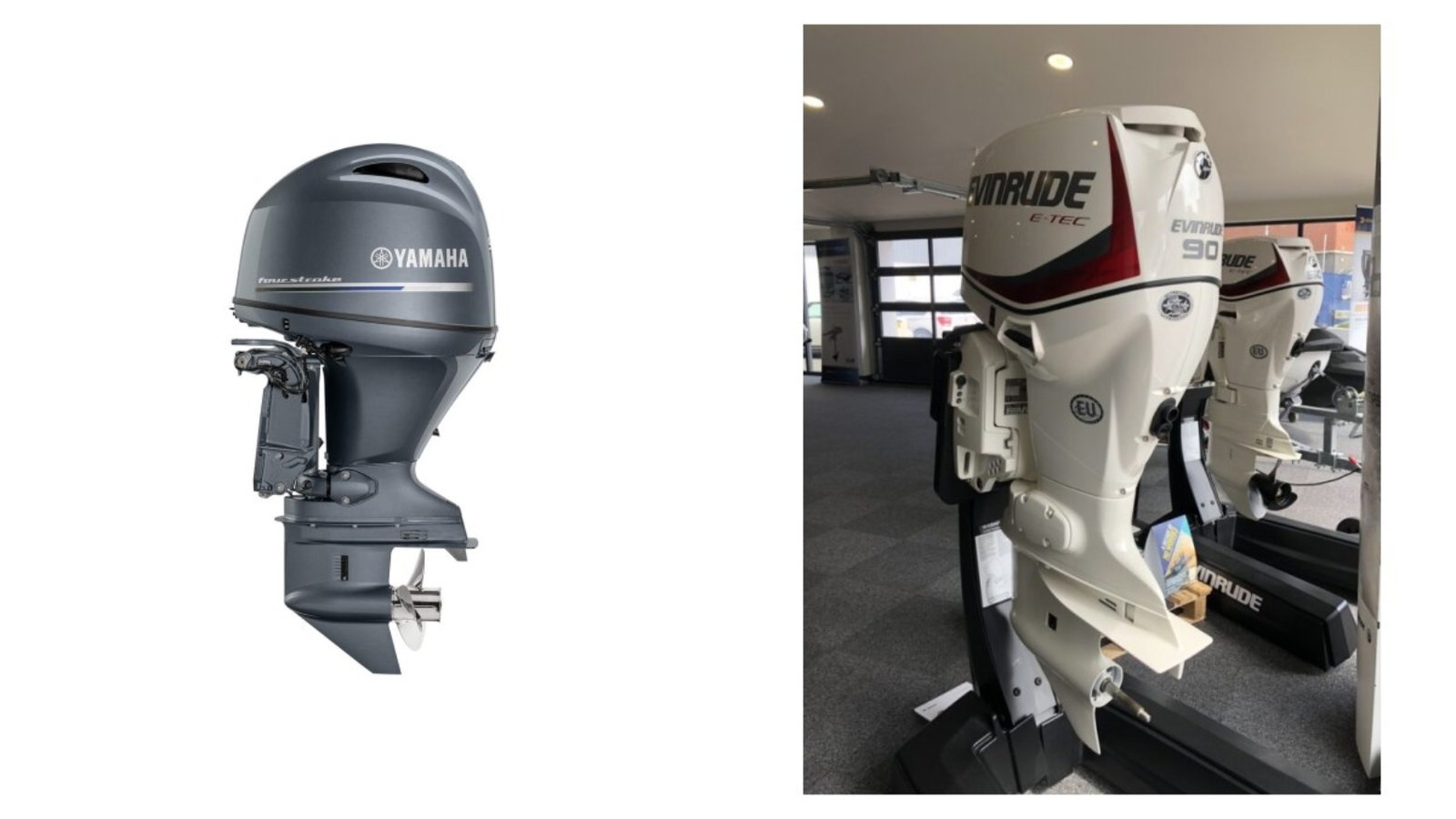
Here’s a common new vs used outboard motor matchup at 90 HP, using two motors we have right now.

SpecUsed Evinrude E-TEC 90 (E90DSL)New Yamaha F90LB
EngineDirect injection two stroke, inline 3Four stroke, inline 4, SOHC
Displacement1,295 cc1,832 cc
WeightAbout 320 lb (145 kg)About 355 lb (161 kg)
Full throttle range5,000 to 5,500 rpm5,000 to 6,000 rpm
Shaft20 inch20 inch
OilInjected two stroke oilCrankcase oil, changed yearly or every 100 hours
ConditionUsed, tested in our shopNew, factory crated
WarrantyAsk us about this unitYamaha factory warranty, terms by country
Our price$4,720$5,835

Both are good motors. The Evinrude is lighter and cheaper. The Yamaha is new, quieter at idle and still in production. Which is better for you is exactly the new vs used outboard motor trade off. See them here: Evinrude E-TEC 90 E90DSL and Yamaha F90LB.

New vs Used Outboard Motor: Two Stroke or Four Stroke?

A lot of used motors on the market are two strokes, and almost every new motor is a four stroke. So the new vs used outboard motor choice is often a two stroke vs four stroke choice too, whether you meant it to be or not.

Modern direct injection two strokes like the Evinrude E-TEC are clean, light and strong. Older carbureted two strokes are a different story. They smoke, they drink fuel, and some lakes and countries now limit or ban them. If you’re looking at an old carbureted two stroke, check your local rules before you buy it.

A used four stroke is usually the safer used buy for a beginner, because it’s what most mechanics work on every day. Just make sure the oil was changed. Ask for receipts, or pull the dipstick and look. Black sludge or a milky look is a bad sign. Our 2 stroke vs 4 stroke outboard guide explains both in more detail.

How Many Hours Is Too Many?

Hours are the first number everyone asks about in a new vs used outboard motor decision. A well looked after four stroke can run 1,500 to 3,000 hours. A two stroke usually runs fewer, often around 1,500 before it needs major work. Recreational boaters put on maybe 50 to 100 hours a year, so a 10 year old motor with 500 hours isn’t old at all if it was cared for.

But hours on their own don’t tell you much. A 300 hour motor that sat with stale fuel and was never flushed can be worse than a 1,200 hour motor that was serviced on time. Many modern motors log hours in the computer, which can be read with a diagnostic tool. Older ones often have no hour meter, and the owner’s word is all you get. We go into this more in how long do outboard motors last.

What We Check Before a Used Motor Goes on Sale

Every used outboard on our site has been through our shop first. Here’s what we do:

  1. Compression test on every cylinder. They should be close to each other. A big difference between cylinders is a warning sign.
  2. Gearcase oil check. Milky oil means water is getting in. Metal on the drain plug magnet means wear.
  3. Test tank run. We start it cold, run it through the gears and check it idles and revs cleanly.
  4. Water pump. We check the tell tale stream and the cooling. Overheating kills outboards.
  5. Corrosion. We look over the lower unit, the bracket, the bolts and the anodes, especially on salt water motors.
  6. Model plate. We record the model and serial number and send you a photo of it before you pay.

If you’re buying a used motor somewhere else, do the same checks or pay a mechanic to do them. Our full checklist is in how to check a used outboard before buying.

Questions to Ask Before You Buy a Used Outboard

Whether you buy from us or someone else, these questions will tell you a lot. A seller who can answer them easily usually looked after the motor.

  • How many hours does it have, and how do you know?
  • Was it used in fresh water or salt water? Was it flushed after every salt trip?
  • When was the gearcase oil changed? When was the water pump impeller replaced?
  • Has it ever overheated, hit something or been under water?
  • Why are you selling it?
  • Can I see it start from cold, and can I see the model plate?
  • Does it come with the controls, harness and prop?

If the answers are vague, walk away. There are plenty of other motors. With every used motor we sell, we tell you what we found in testing and send photos of the exact unit, so you’re not guessing in the new vs used outboard motor decision.

The Hidden Costs Nobody Mentions

The sticker price isn’t the whole story in new vs used outboard motor. Watch for these:

  • Controls and gauges. If your old controls don’t match the motor, you’ll need new ones. This can add a good amount to a repower. Digital throttle and shift motors need their own controls.
  • Propeller. A used motor might come with the wrong prop for your boat, or a damaged one. Our outboard propeller guide helps you pick.
  • First service. On any used motor, we’d change the gearcase oil, impeller and plugs right away so you start fresh.
  • Shaft length. A used bargain with the wrong shaft isn’t a bargain. Check our outboard shaft length guide.
  • Rigging. Steering, cables and wiring may need work either way, new or used.

A new motor usually comes with fewer surprises, and that’s a fair point in the new vs used outboard motor debate. It’s part of what you pay for.

What a Factory Warranty Actually Covers

Warranty is one of the biggest points in favor of new in any new vs used outboard motor comparison, so it’s worth knowing what you’re getting. A factory warranty covers defects in materials and workmanship for a set period. It doesn’t cover damage from hitting rocks, running without water, bad fuel or skipped maintenance. Most makers also expect the motor to be serviced on schedule, so keep your receipts.

Terms vary by brand and by country, and some brands offer longer cover in some markets. We tell you the warranty terms that apply in your country before you order a new motor. For a used motor, we tell you whether any factory cover is left on that serial number.

When a New Outboard Makes More Sense

In the new vs used outboard motor choice, go new if any of these sound like you:

  • You want a motor under 30 HP. As the price table shows, new is often the same price or cheaper.
  • You’ll keep the boat a long time and want to know the full history.
  • You run in salt water a lot and want the best corrosion protection from day one.
  • You want a full factory warranty.
  • You can’t easily get a used motor checked or fixed where you live.

Good new picks from our stock: the Mercury 9.9MH at $1,272, the 2021 Yamaha 9.9 HP at $1,350 (new and unused), the Mercury 25 EFI at $2,290, the Mercury 115ELPT at $6,390, and the Yamaha F200XB at $9,974, a 2.8 liter inline four.

When a Used Outboard Makes More Sense

Used wins the new vs used outboard motor choice if:

  • You need 60 to 150 HP and your budget is tight.
  • You’re rigging twins and want to save thousands.
  • You want a backup or a kicker that won’t see many hours.
  • Your boat is older and doesn’t justify a brand new motor.
  • You can buy one that’s been properly tested, with photos of the exact motor.

Good used picks right now: the Evinrude E60DGTL 60 HP at $4,300, the Evinrude E-TEC 90 at $4,720, the Evinrude E135HSL at $7,230, the Mercury 40ELHPT Command Thrust SeaPro, a lease return, and the Mercury 300XXL SeaPro pair at $17,500. You’ll find more on our used outboard engines page and across the Evinrude range.

Where to Buy a Used Outboard, and Where Not To

Where you buy matters a lot in new vs used outboard motor. Private sales are where the cheapest motors are, and also where most of the bad ones are. You can find a gem, but you need to know what to check, and you usually have no comeback if it dies a week later.

Buying from a shop costs a little more, but the motor should have been tested, and you have someone to call. That’s what we try to be. Every used motor on our site has been through the checks above before it’s listed.

For general advice on buying and owning a boat motor, the boat owners association BoatUS has good free articles, and the US Coast Guard’s boating safety site covers the safety gear and rules you’ll need whatever motor you buy.

One more tip from experience: be very careful with a used motor that’s priced far below everything else. Stolen outboards do get sold online. Always ask to see the model plate and serial number, and walk away from any seller who won’t show them.

A Word on Used Evinrude Motors

A lot of the used motors on our site are Evinrudes, so it’s worth being clear. BRP stopped making Evinrude outboards in 2020. That’s a big reason these motors are good value now. Parts for the common E-TEC models are still easy to get, but some electronic parts take longer. If you’re weighing a used Evinrude against a new four stroke, read our Evinrude vs Mercury outboard comparison first.

New vs Used Outboard Motor for Different Boats

The best new vs used outboard motor answer changes with the boat.

Dinghy, tender or canoe

Buy new. Small motors are cheap new, and old carbureted small motors are the ones most likely to give fuel trouble. See portable outboard motor for sale.

Jon boat or aluminum fishing boat

New at 25 to 30 HP. Used makes sense at 40 to 90 HP. Our outboard motor for fishing boat guide has picks.

Pontoon

Either. Pontoons are easy on motors, so a tested used 90 or 115 is a good buy. See outboard motor for pontoon boat.

Bass boat

Many bass anglers buy used E-TECs for the hole shot and price. If you want the newest speed motor, go new Pro XS. See bass boat outboard motor for sale.

Offshore center console

New if you run far offshore and need total reliability. A tested used pair if budget matters more. See center console outboard motor for sale and twin outboard engines for sale.

Our Honest Advice on New vs Used Outboard Motor

We’ve been selling motors long enough to see how this plays out. People who buy cheap used motors from strangers without checking them are the ones who end up calling us a few months later for a new one. People who buy a tested used motor at a fair price are usually very happy. And people who buy new almost never regret it, they just wish it had cost less.

So our advice on new vs used outboard motor is this: decide on the size first, then compare our new and used prices for that size. If the gap is small, buy new. If the gap is big and the used motor has been tested, used is a smart buy.

If you want to be sure the motor itself is a good one, have a look at our list of the most reliable outboard motor picks. You can also buy from us with confidence: read our customer reviews first.

How to Order a New or Used Outboard From Us

  1. Pick a motor from this page or the shop.
  2. Tell us your boat and transom height so we can confirm the shaft and prop.
  3. Order on the product page, or call or WhatsApp +1 209 690 5983.
  4. For a used motor, we send photos and the model plate of the exact unit before you pay.
  5. We confirm shipping to your country. Outboards ship free, crated and tracked. See outboard motor with free shipping and how we ship overseas.

New vs Used Outboard Motor FAQ

Is it worth buying a used outboard motor?

Yes, if it’s been tested and the price is well below a new motor of the same size. In the 60 to 150 HP range and for twin motors, the savings are often worth it.

How much cheaper is a used outboard than new?

It depends on size. In our store small used motors cost about the same as new ones, while a used 90 or 135 HP saves around $1,100 to $1,300 and a used pair of 300s saves thousands.

What is good hours on a used outboard?

Under 100 hours a year of age is normal. Care matters more than hours. A serviced motor with high hours can beat a neglected one with low hours.

Do used outboards come with a warranty?

Some have factory warranty left, many don’t. Ask about the exact motor. New motors from us come with the maker’s warranty, with terms that depend on your country.

Should I buy new or used for salt water?

New if you can. If you buy used, check for corrosion closely and ask how it was flushed.

Is a new outboard more reliable than a used one?

At first, yes, because nothing has worn yet and you know its history. A well kept used motor from a reliable brand can be just as dependable for years, which is why the new vs used outboard motor choice is often closer than people think.

Can I return a used outboard?

Our refund and returns policy covers both new and used motors. Read it before you order, and ask us if anything isn’t clear.

Do you ship new and used outboards worldwide?

Yes. We ship both kinds worldwide and confirm the cost before you pay.

Final Word on New vs Used Outboard Motor

There’s no single right answer to new vs used outboard motor, but there is a right way to decide. Pick the size, compare real prices, and only buy used if it’s been tested and the savings are worth it. Under 30 HP, buy new. In the middle sizes and for twins, a good used motor can save you a lot. We have both on the shelf. Questions? Call or WhatsApp +1 209 690 5983, use our contact page, or learn more about us.

Related: Outboard repower for sale | Cheap outboard motors for sale | 2 stroke vs 4 stroke outboard

how to check a used outboard before buying

How to Check a Used Outboard Before Buying: 15 Proven Checks to Avoid a Bad Motor

Knowing how to check a used outboard before buying can save you thousands. We test every used motor that comes into our shop in Fresno, California before we sell it, and we’ve seen just about every trick and every hidden problem there is. This page is the same checklist we use on our own bench, written so you can use it in someone’s driveway with a few basic tools.

We sell tested used outboards and new ones, and we ship worldwide. But even if you buy your motor somewhere else, these 15 checks will tell you if it’s a good motor or a money pit. Here’s how to check a used outboard before buying, step by step.

how to check a used outboard before buying
How to check a used outboard before buying

Why a Used Outboard Is Worth Checking Properly

A clean cowling tells you nothing. Some of the worst motors we’ve seen looked great on the outside, with fresh decals and a shiny coat of spray. Meanwhile the powerhead had low compression, the gearcase was full of water, and the cooling passages were packed with salt.

The big repairs on an outboard are powerhead rebuilds, lower unit rebuilds and corroded cooling systems. Any of them can cost more than the motor is worth. Learning how to check a used outboard before buying takes maybe an hour, and that hour is the best money you’ll never spend.

Tools You Need to Check a Used Outboard Before Buying

  • A compression tester with the right thread for spark plug holes, usually 14mm
  • A spark plug socket and ratchet
  • A flat screwdriver for the gearcase drain plug
  • A clean jar or white cup to catch some gear oil
  • Rags and a flashlight
  • A set of muffs (flush ears) and a garden hose, or a test tank
  • Your phone, to photograph serial numbers and anything odd

If the seller won’t let you do a compression test or drain a little gear oil, walk away. Nobody with a good motor has a reason to stop you.

Before You Check a Used Outboard Before Buying: Ask the Seller

Part of how to check a used outboard before buying happens on the phone. Ask these before you drive anywhere:

  • What year and model is it, and what’s the serial number?
  • Has it been used in salt water or fresh water?
  • How many hours? Can I read the hours with a diagnostic tool?
  • When was the water pump impeller last changed?
  • Do you have service records?
  • Can I see it start from cold?
  • Why are you selling it?

Vague answers aren’t always a lie. Plenty of honest owners don’t keep records. But if the story changes between the phone call and the visit, be careful.

The 15 Checks: How to Check a Used Outboard Before Buying

1. Serial number and paperwork

Find the ID plate on the transom bracket. Photograph it. Make sure the serial number hasn’t been scratched off or tampered with, and that it matches any paperwork. In many places you can check if a motor has been reported stolen. A missing or damaged plate is a red flag on its own.

2. Insist on a cold start

Tell the seller not to run the motor before you arrive. Put your hand on the powerhead when you get there. If it’s warm, ask why. A motor with a weak starting problem or low compression starts much easier when it’s already warm, and sellers know this.

3. Look over the outside

Walk around the whole motor. Look for:

  • White, crusty corrosion around the exhaust outlet, the anode, and where the midsection meets the gearcase
  • Bubbling paint, which often means corrosion underneath
  • Cracks or welds on the transom bracket or swivel bracket
  • Missing or worn out zinc anodes
  • A skeg that’s been ground down or welded, which tells you it has hit bottom hard
  • Fresh paint on just the gearcase, which can hide damage

Take the cowling off. Anyone who knows how to check a used outboard before buying does this, because the outside hides a lot. Look for oil leaks, burnt or cracked wires, chewed wires (mice love outboards), and signs of overheating like discolored paint on the powerhead.

4. Prop and prop shaft

Pull the prop if you can. Most people who learn how to check a used outboard before buying skip this, and they shouldn’t. Fishing line wraps around the shaft and cuts the seal, which lets water into the gearcase. Spin the shaft and look for a bent shaft or wobble. A badly chewed prop is cheap to replace, but it tells you how the motor was used.

5. Gearcase oil

Gear oil is one of the most important parts of how to check a used outboard before buying. Remove the lower drain plug and let a little oil run into your cup. Then put the plug back.

  • Clean, amber or honey colored: good.
  • Milky or creamy: water is getting in. Seals need replacing at least.
  • Water comes out first: bad. The gearcase has been holding water for a while.
  • Metal shavings or a furry coating on the magnetic plug: gears or bearings are wearing. A little fine paste is normal. Chunks and flakes are not.
  • Burnt smell or black oil: the gears have been run low on oil or overheated.

6. Compression test

Every guide on how to check a used outboard before buying puts this near the top. Pull all the spark plugs and keep them in order. Screw the gauge into the first cylinder, open the throttle all the way, and crank the motor several times until the needle stops climbing. Write it down. Do every cylinder the same way, and do it on a cold motor if you can.

Most healthy small motors read roughly between 100 and 150 psi, but the exact spec depends on the model, so look it up. What matters most is that every cylinder is within about 10 percent of the others. One low cylinder means rings, valves or a head gasket. Every cylinder low means a tired motor. If you only do one thing on our list of how to check a used outboard before buying, do this one.

7. Spark plugs

While the plugs are out, look at them. Light tan is normal. Black and wet with oil can mean worn rings. White and blistered means it’s been running lean and hot. One plug that looks different from the rest points to a problem in that cylinder.

8. Fuel system

Fuel problems are common on motors that sat, so they belong in how to check a used outboard before buying. Look at the fuel lines and primer bulb. Cracked lines and a bulb that won’t firm up mean air leaks. Smell the fuel in the tank. Stale fuel smells like varnish, and it means the motor has been sitting, which on a carbureted motor often means gummed jets. On EFI motors, ask if the fuel filters have been changed.

9. Cooling system and tell tale

Cooling is a big part of how to check a used outboard before buying, and it’s easy. Never run a motor without water. Put it in a test tank, on muffs with the hose running, or in the water. Start it. Within a few seconds you should see a steady stream from the tell tale, the little pee hole on the side. A weak or no stream can be a blocked tell tale, which is easy, or a worn impeller or blocked passages, which aren’t. Run it a while and feel the powerhead. It should get warm, not too hot to touch. Any overheat alarm is a problem.

10. Shifting

Shifting is a quick part of how to check a used outboard before buying. With the motor running in water, shift into forward, neutral and reverse a few times at idle. It should shift with a firm clunk and no grinding. The prop should not turn in neutral. Hard or crunchy shifting means a worn clutch dog or shift linkage problem.

11. Idle, throttle and smoke

Idle quality says a lot, so don’t rush this part of how to check a used outboard before buying. A good motor idles smoothly once warm. Roll the throttle up and down. It should rev cleanly without stumbling or dying. Some smoke at startup on a two stroke is normal. Blue smoke from a four stroke, or lots of smoke from any motor once warm, is not.

12. Engine hours

Many newer motors store hours and fault codes in the computer. Mercury, Yamaha, Suzuki, Honda and Evinrude E-TEC motors can all be read with the right diagnostic tool, and a dealer can do it for a small fee. Ask the seller for a printout. Anything under 100 hours a year is normal use. Low hours and lots of corrosion don’t add up. Knowing how to check a used outboard before buying means checking the story against the motor.

13. Power trim, tilt and steering

Run the trim all the way up and down. Listen for a smooth, even motor sound. Look for hydraulic fluid leaking from the rams. Trim units are pricey to fix, which is why they belong in how to check a used outboard before buying. With the motor tilted up, it should hold its position and not slowly sink. Turn the steering lock to lock. It should be smooth and not loose.

14. Electrical and charging

Check the battery cables, the key switch and the kill switch lanyard. On an electric start motor, the starter should crank hard. If the motor has a charging system, a cheap meter on the battery should show the voltage rise a little once the motor’s running above idle.

15. Water test under load

Running on muffs only tells you so much about how to check a used outboard before buying properly. If you can, run the boat. Get it on plane, hold it at wide open throttle for a minute, and watch the RPM. It should reach the maker’s recommended range. Bring it back to idle and check the tell tale again. A water test is the last step in how to check a used outboard before buying, and it’s the one that catches problems that only show under load.

Quick Checklist Table

CheckGood signWalk away if
Serial plateClear, matches papersMissing or ground off
Cold startStarts in a few pulls or cranksSeller pre-warmed it and won’t let it cool
Gear oilClean and amberMilky, watery or full of metal chunks
CompressionAll cylinders within about 10 percentOne cylinder much lower
Tell taleStrong steady streamWeak stream and overheat alarm
ShiftingFirm clunk, no grindingGrinding or jumps out of gear
CorrosionLight surface marksBubbling paint, crusty exhaust, eaten bracket
Trim and tiltSmooth, holds positionLeaks or sinks when tilted

Print this out and take it with you. It’s the short form of how to check a used outboard before buying.

Red Flags When You Check a Used Outboard Before Buying

  • The seller won’t allow a compression test.
  • The motor was warm when you arrived and the seller won’t wait.
  • Milky gear oil and the price isn’t adjusted for it.
  • A tampered or missing serial plate.
  • Fresh paint only on the parts that usually show damage.
  • The motor has to be started with starting fluid.
  • Heavy corrosion on a motor sold as fresh water only.
  • Low hours on the story, but the computer says otherwise.

Two Stroke vs Four Stroke: What Changes

The steps for how to check a used outboard before buying are mostly the same for both, with a few extras.

On a two stroke, ask if it’s premix or oil injected. On oil injected motors, make sure the oil pump and warning system work. Oil injection failures have killed a lot of older two strokes. Direct injection two strokes like the Evinrude E-TEC are good motors but need the right oil and a diagnostic check.

On a four stroke, pull the dipstick. The oil should be clean and at the right level. Milky oil is very bad news. Oil that smells of fuel means it has been running rich or sitting with a stuck carb float. Ask when the oil was last changed, and look for a valve clearance check in the records on bigger motors.

Salt Water vs Fresh Water Motors

Where the motor was used changes how to check a used outboard before buying. A fresh water motor that’s been looked after can easily last thousands of hours. A salt water motor that was never flushed can be eaten from the inside long before that. That doesn’t mean you should never buy a salt water motor. Many are flushed after every trip and are in great shape. But look harder at the cooling passages, the exhaust area, the thermostat housing and every place two metals meet. If you see heavy white crust inside the cowling, think twice.

What Should You Pay?

Once you know how to check a used outboard before buying, the price talk gets easier. Prices for used outboards vary a lot by country, brand and condition, so we won’t give you a single number. A good rule is to compare against the price of a new motor of the same size. If a used motor is priced close to new, it had better be nearly new. Our cheap outboard motors for sale page shows new motors from $390, and a new Mercury 9.9MH is $1,272 in our store. Sometimes new is the smarter buy.

Take off money for anything you find. Gearcase seals, a new impeller, new plugs, a fuel pump and a carb clean all add up. Get a rough quote from a local mechanic for each item and use that in your offer. Knowing how to check a used outboard before buying gives you real numbers to negotiate with.

Used or New? Compare Before You Decide

Part of how to check a used outboard before buying is checking the price of a new one. In some sizes the gap is small enough that a new motor with no history makes more sense. Here are a few new motors from our stock to compare against:

New motorHPOur price
Mercury 2.5MH2.5$885
Tohatsu MFS6DWS6$1,695
Yamaha F9.9SMHB9.9$1,590
Suzuki DF9.9BS59.9$2,640
Mercury 20MH EFI20$2,013
Yamaha F25LMHC25$3,299
Mercury 40MHGA40$3,093
Yamaha F60LB60$4,780
Yamaha F90LB90$5,835
Yamaha F200LCA200$9,000

If a used motor is within a few hundred dollars of these, we’d buy new. If it’s half the price and passes every check, used can be a great deal.

Buying a Used Outboard From Us

We know how to check a used outboard before buying because we do it every week. We do the work above on every used motor before it’s listed. Each one is checked for compression, gear oil, cooling and shifting, and run in a test tank. We tell you what we found. If you’re buying from far away and can’t check the motor yourself, that matters.

If you’d rather skip the risk, we also sell new motors from every big brand. Browse Yamaha, Mercury, Suzuki, Honda and Tohatsu, or see our pick of the best 9.9 HP outboard models.

Buying Used Online When You Can’t See the Motor

If you’re buying from a seller far away, you can’t do every step of how to check a used outboard before buying yourself. Ask for these instead:

  • A video of a cold start, with the cowling off, showing the tell tale
  • A video of shifting through forward, neutral and reverse
  • Photos of the compression gauge on each cylinder, with the gauge visible
  • A photo of gear oil draining into a white cup
  • A photo of the serial plate
  • A diagnostic printout of hours and fault codes

That list is how to check a used outboard before buying from a distance. A good seller can send all of this in a day. If they won’t, move on. Our buy outboard motor online guide has more tips, and you can read what other buyers say on our reviews page.

Matching the Motor to Your Boat

The last part of how to check a used outboard before buying has nothing to do with the motor’s health. A perfect motor is still a bad buy if it doesn’t fit. Check that the shaft length matches your transom height. Short shaft motors are 15 inch, long shaft are 20 inch, and extra long are 25 inch. Check that the horsepower is within your boat’s rating, and that you have the controls you need. Remote motors need cables, a control box and gauges, which add cost. Tiller motors don’t. Our guides on long shaft outboards, tiller outboards and electric start outboards will help.

After You Buy: First Jobs

Once you’ve worked through how to check a used outboard before buying and the motor is yours, give it a fresh start. We’d do these straight away:

  1. Change the water pump impeller unless you have proof it was done recently.
  2. Change the gear oil and check the drain plug washers.
  3. Change the engine oil and filter on a four stroke.
  4. Fit new spark plugs.
  5. Replace the fuel filter and any cracked fuel lines.
  6. Replace the anodes if they’re more than half worn.
  7. Grease every fitting.

It costs a little, but you’ll know exactly where you stand. Good general boat care advice is on BoatUS and Discover Boating.

How to Check a Used Outboard Before Buying: FAQ

What is a good compression reading on an outboard?

It depends on the model, so check the spec. Most small motors fall roughly between 100 and 150 psi. Cylinders being within about 10 percent of each other matters more than the exact number.

How many hours is too many on a used outboard?

Care matters more than hours. A well maintained four stroke with 1,000 hours can be a better buy than a neglected one with 300.

Can I check a used outboard without running it?

You can check compression, gear oil, plugs and corrosion without running it. But you should always see it run in water before you pay.

What is the most important step in how to check a used outboard before buying?

The compression test, followed closely by the gear oil check. Together they tell you about the two most expensive parts of the motor.

Is it safe to buy a used outboard online?

Yes, if you get videos and photos of every check, or buy from a seller who tests the motor first, like we do.

How long does it take to check a used outboard before buying?

About an hour if you include a compression test and running it on muffs. Longer if you water test the boat.

Do you ship used outboards worldwide?

Yes. Tell us your country and we’ll confirm shipping before you pay.

Final Word

Now you know how to check a used outboard before buying, the same way we do it. Bring the tools, insist on a cold start, test compression, drain a little gear oil, watch the tell tale and shift it through every gear. If it passes all that, you’ve probably found a good motor. If you’d rather buy one that’s already been checked, or go new, call or WhatsApp us on +1 209 690 5983, or use our contact page. You can also browse the shop or read more about us.